Showing posts with label pre-calculus. Show all posts

Saturday, November 30, 2013

Polar Coordinates and Equations--More than Pretty Pictures!


Great use for cardioid graphs!
Since our study of polar graphs and coordinates was abbreviated (and we had Thanksgiving in between) I wanted to provide a few resources for you to help with your test review, so here you go:

Written resources:
Video/Interactive Resources (most require Java):
  • Video tutorial of basics of polar coordinates and graphs
  • Great interactive site to explain polar
  • Interactive sites to create polar graphs (like our "web assignment") - found here and here 
  • And don't forget my new favorite website for a graphing calculator: Desmos!

If you find another resource that might help a classmate, please list it in the comments below.

Sunday, June 2, 2013

Hooray for the End!

I can't believe it's already time to end the year!  It seems like you were just here last week completing your math-ography and survey.

Here's one last post for you, and I would really appreciate your feedback.  I think it is very important to reflect and learn from each experience, so I would like to know what you think about our class and my teaching.  In addition, for my "other" job, I think your feedback about teaching in general could help teachers new to LHHS.  The last part of the questionnaire asks you to reflect a bit on your own year.

I have created this survey that you may complete at any time this week.  Your feedback will help me improve my teaching, but please be considerate about how you respond.  (I accept your constructive criticism, but please justify your responses--just like on our tests!)  You do not have to include your name, and you do not need to complete every question.

If you want to share your summer plans, feel free to post in the comments.  (My sister will be here in 2 weeks, so for me, summer starts with family fun!)

A few end of year quotes for you...

“Believe in your dreams and they may come true; believe in yourself and they will come true.”

“Nurture your mind with great thoughts; to believe in the heroic makes heroes.”


“Even a mistake may turn out to be the one thing necessary to a worthwhile achievement.”

Thanks so much for your time!
More importantly, thanks for a great year!

Sunday, April 7, 2013

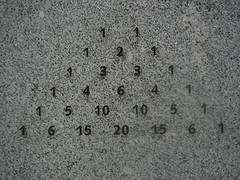
Math-Magic with Pascal and Fibonacci


The purpose of the "web" assignment is to give you time to simply browse.  I hope you enjoy exploring different sites to see examples of some true mathmagic!

Click here for a link to the document for today's assignment.

And here's a new web tool I've wanted to try.  It's called "Thinglink," and you can embed links within the image.  Don't know if you'll get to explore Sierpenski triangles and fractals today, but they're very cool and related to Pascal's triangle, too!  I've attached a few links, and if you find something else fun, please try adding new links to this image.


Please share!
By Tuesday, April 9, 5 PM, please post (in the comments below) a sentence or two about the most math-magical thing you discovered about Pascal’s triangle, the Fibonacci sequence, or Phi.  What was fun, interesting, cool, or made you ooh and aah??  Please share!

Thank you, and have fun!

Sunday, March 24, 2013

Let's Hear Your Voice!

Thanks again for your willingness to try a new technology tool!

You must first register with Voice Thread.

Once you register, you may search for our slides, or simply click the links below.  Feel free to look at both slide shows, and I will grade your comments left on either presentation.  (Sorry about any blurry pictures!)

1st period's work:


3rd period's work:


If you can think of any ways other ways students/teachers might enjoy using Voice Thread, please leave your comments on the slideshow or post a comment below.

Thank you!

Sunday, March 17, 2013

A Math Super Power!

Several years ago, Steve Strogatz, an award winning mathematician from Cornell, wrote a series of 15 articles in the New York Times Opinionator blog. He is a professor who really understands math-magic, and he wanted to explain it from the beginning of numbers to advanced calculus.  The entire series may be found here, and if you're looking for good math reads, check out all of the articles, in order.  I promise, the articles are engaging and entertaining, and in fact, in his first post, he uses a clip from Sesame Street to explain the importance of numbers. How brilliant is that?!?

In math, we don’t often have opportunities for reading and writing, so when the series was first published, I kept looking for ways to incorporate it into my classroom...so now you'll get to respond on this blog! :-)


In your next opportunity to post for points, please read his article called "Power Tools," (which I also gave you before the break) and summarize the material using a 20 word gist.  Write a complete sentence (or I’ll even take a coherent phrase) using only 20 words.  You may summarize the entire article, one particular piece of the article, or you may draw a conclusion about the article, but you must do so using only twenty words.  More importantly, your sentence/phrase must make sense!  

Please don't forget to include either your first name or initials so that you can receive your extra credit points!

Once again...your sentence must make sense, relate to the article, and use EXACTLY 20 words.


Please post your comments by 5 PM on Friday, March 22.  
Have fun, and thanks for playing!
As always, I look forward to reading your responses.


Saturday, November 24, 2012

Not Quite the North Pole, but Almost as Fun!

When I first mentioned polar coordinates, did you immediately think "North Pole!" and then "Santa?"  (I know that's the way my mind works every time I think about polar graphs, especially at this time of year!) 

(And since we're talking North Pole, I'll share some KLas family trivia... I've told you that my sister lived in Alaska for a long time, and her wedding was almost exactly 8 years ago...happy anniversary Allison & Steve!  So when our entire family ventured to Alaska for her wedding during Thanksgiving, 2004, we had to go to North Pole, Alaska, shop at the Santa Clause house, and take a picture of the real north pole!)

That's my dad with me...& yes, there are geocaches close by!
Is that Rudolph, peeking around the corner?
Visiting the North Pole is oh-so-much fun, but look at the possible graphs you can make...doesn't that look like fantastic fun, too?! ;)  And you you will be able to create these graphs by the end of the week...no winter visits to Alaska required!


Great use for cardioid graphs!
Since our study of polar graphs and coordinates will be abbreviated, I wanted to provide a few resources for you to help with your studies, so here you go:

Written resources:
Video/Interactive Resources (most require Java):

If you find another resource that might help a classmate, please list it in the comments below.  If you create a cool polar graph, take a screen shot and email it to me, and I'll post it here!

Aren't polar graphs cool?


Tuesday, September 25, 2012

Sinusoidal Functions as Math Models HELP

OK, I know you can do these problems, but it definitely takes some practice!  I've watched several videos and found a few links to help you.  I also created a tiny "video" using the Educreations app.  You should be able to watch my videos just fine from your computer, but if you're on an iPad, you have to download the free app.  Unfortunately, this video does not work on an iPhone. :-(
  • My video on solving a sinusoidal equation algebraically involving a cosine.
  • When is Fiona an ogre vs. a princess?  Use this video to find out!
  • Here's an explanation of a water wheel problem.  Thanks, emathguy!
  • This PDF shows several problems worked completely.  The problems are even some of the same ones I've assigned, and at a quick glance, they look good, but I haven't checked all of the work.
  • One more PDF of some similar problems worked.  I like this one because it shows a few distinct steps (looking for a max/min point, writing an equation as a sine or cosine, etc.) But again, I didn't work through all of the problems for correctness, so use at your own risk! :-)
  • The answers to the "Practice Test" are the photos below, and all steps are shown for the algebraic equations:


The answers to your two practice worksheets are posted on EdLine.

Most of these problems (and the ones from the video) were taken from the green trig book (Foerster) section 2.12.  The odd answers are in the back of the book, of course!

If you find any other great hints, please share in the comments below!


From your comments on your exit ticket: one person asked for problems worked out completely, so I posted those equations above.  Another specific question asked about how do you determine whether your graph is a sin x or cos x (or -sin x or -cos x).

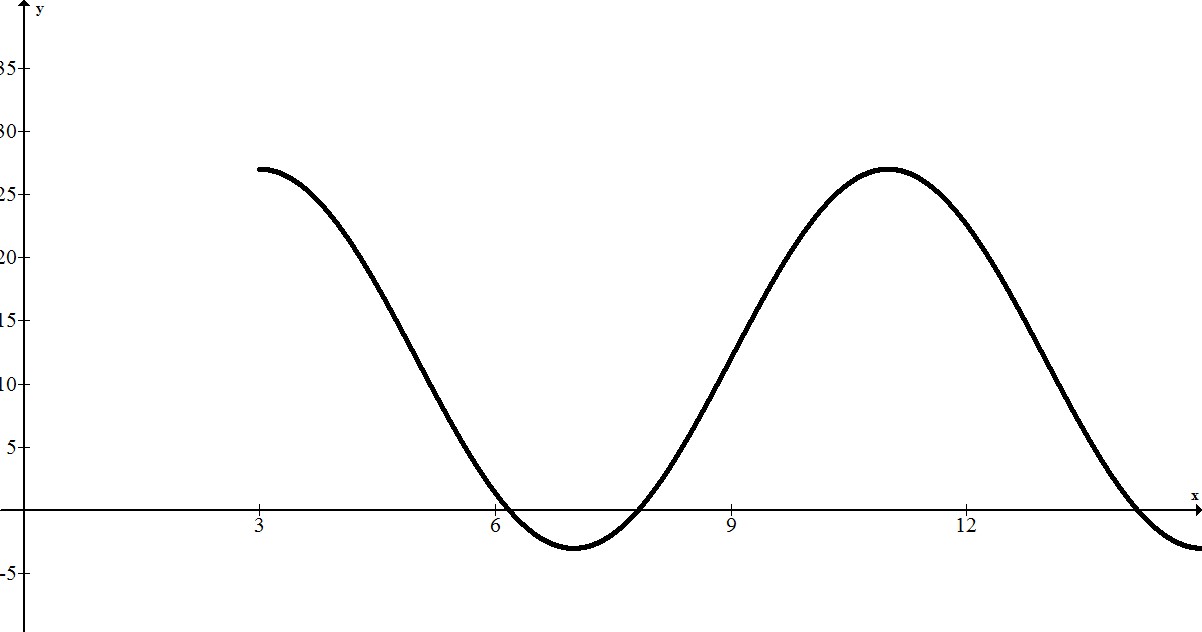
  • If the first point you plot is a maximum point, your graph is most likely a cosine because your point is ABOVE the shifted x-axis.
positive cosine--starts at a MAX
  • If  the first point you plot is a minimum point, your graph is most likely a negative cosine because your point is ABOVE the shifted x-axis.
negative cosine--1st point is a MIN
  • If the first point says something about "the middle" (or the average, equilibrium, at rest, etc.) your graph is most likely a sine graph.  If the object then is pulled down (or something similar) your function is a negative sine.  If the object then moves upward, the function is a positive sine.
negative sine--"middle and down"

positive sine--"middle and up"